


Key takeaways
- Direct vs. reseller bundling: control is the real trade-off. Both models work, what differs is who owns the commercial relationship long-term.
- Reseller platforms are faster to launch, slower to optimize. Less integration work, but less say over timing, offers, and partner relationships, and white-label hubs can let subscribers churn freely.
- Direct partnerships mean full control. Providers set the partners, terms, and pace across telco and non-telco under one clean agreement, with no renegotiation per partner.
- A third option exists: standardized tech, direct commercials. One integration layer, no reseller sitting between provider and partner.
- Boku connects providers to 110+ partners in one integration commercial control stays with the provider. Scale without giving up the relationship.
Two ways to approach bundling partnerships
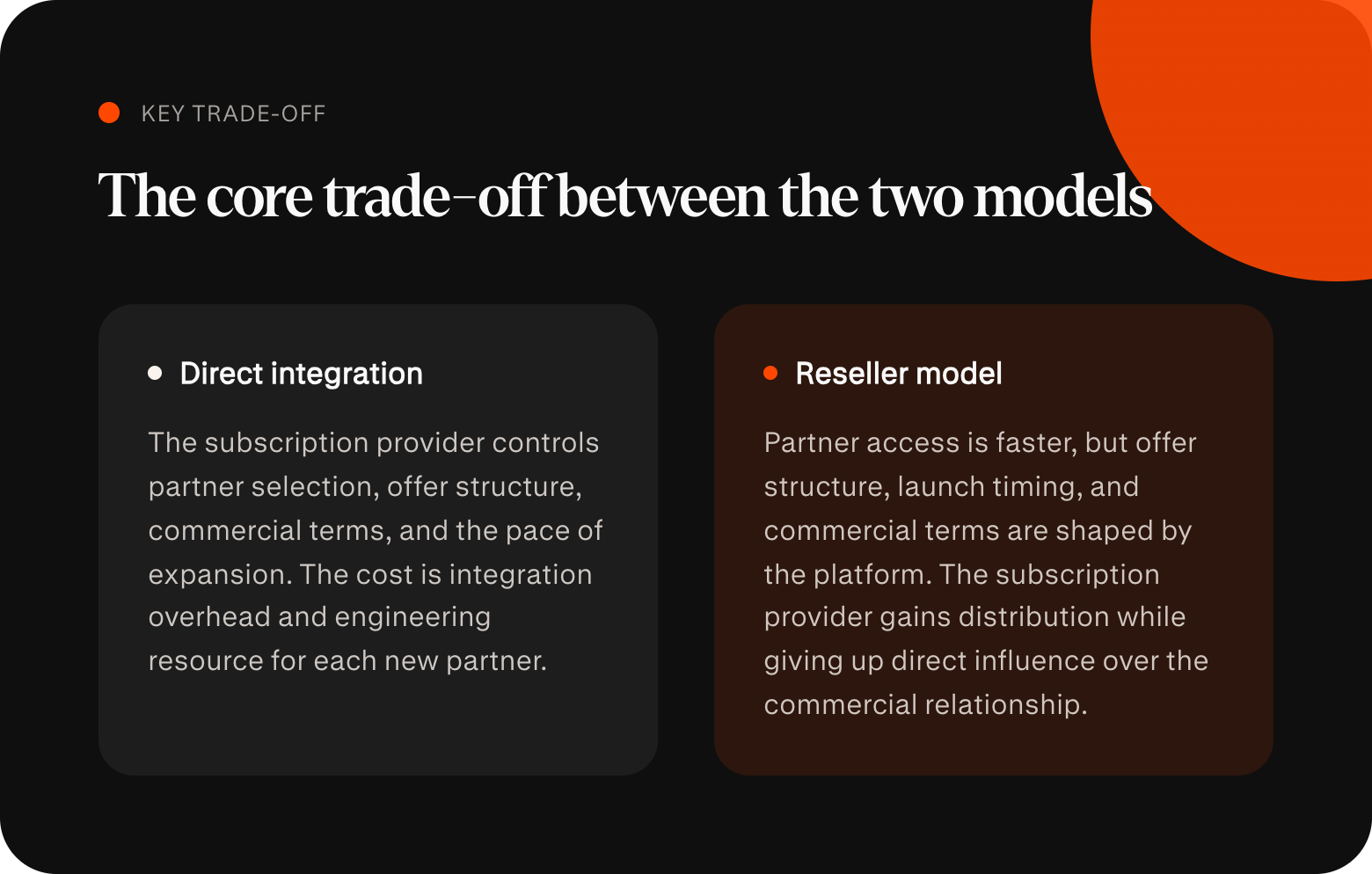
When subscription businesses decide to expand through partner distribution, they face a choice between two approaches. Direct integrations mean negotiating individually with each partner, integrating technically, and managing the relationship end to end. A reseller model means connecting once to a single platform and gaining access to its existing partner network, with less integration overhead than a direct build but less direct influence over the commercial relationship.
The trade-off that matters most over time is who controls the relationship.
What changes when distribution goes through a reseller
The appeal of reseller distribution comes from the fact that a single integration unlocks access to a network of partners without a separate build for each one.
Launch timelines are faster, onboarding is standardized, and the integration overhead that makes direct connections so resource-intensive is largely removed.
There is a structural limit to that reach, though. A reseller’s partners are mostly telcos that have gone through an enterprise sales cycle to adopt the platform. That can slow rollout, leave gaps in market coverage, and cap a subscription provider’s ability to acquire high-quality subscribers at volume.
The commercial model also works differently from a direct partnership. In most reseller structures, the platform sits between the subscription provider and the end partner. Launch timing depends on platform and partner readiness rather than the provider’s own roadmap. Offer configuration is subject to platform limitations. Commercial negotiations happen within a framework set by the intermediary rather than directly between provider and partner.
Reseller platforms also tend to own the consumer-facing experience through white-label subscription hubs, the branded interface the subscriber sees. Some of these hubs let subscribers pause or switch subscriptions whenever they want. That convenience sits with the platform, and it can work against the subscription provider’s retention and lifetime value.
Over time, the provider has less direct influence over launch timing, offer configuration, and how the relationship develops. Stronger partner relationships can secure better marketing support, stronger placement, and faster resolution of operational issues. When a platform mediates the relationship, the provider has fewer direct levers to improve those outcomes.
| ~60% average retention through Boku’s telco partnerships |
What owning your subscription bundling partnerships actually means
Owning a subscription bundling partnership means the subscription provider decides which partners they work with, on what timeline, in which markets, and on what terms, across both telco and non-telco partners, such as banks, wallets, and commerce platforms. They can negotiate pricing, promotional commitments, and reporting requirements directly, rather than accepting whatever a platform has standardized.
Direct ownership also keeps the commercial relationship clean. When a provider works through Boku, Boku is paid only by the subscription provider and represents that provider in negotiations. In a reseller model, the platform is often paid by both the subscription business and the partner, so pressure from one side to improve its terms can carry through to the provider’s own pricing.
There is a practical benefit too. A subscription provider working with Boku signs a single commercial agreement that does not need renegotiating each time they add a partner. That removes rounds of negotiation meetings, frees teams to focus on the launch itself, and makes budgeting more predictable.
The relationship can also develop over time. As both sides accumulate data on what drives activation, conversion, and retention among their shared subscribers, a provider with a direct relationship can renegotiate terms and shape future offers around what they have learned. A reseller platform can provide analytics, but because its primary job is to support the partner, the subscription provider often receives limited data without dedicated support. That makes ongoing commercial development harder to pursue.
Negotiating subscription bundling deals at scale calls for a commercial framework that applies consistently across partners while staying flexible enough to reflect the specifics of each relationship.
The subscription providers that build the strongest partner portfolios treat each agreement as the foundation of a long-term commercial relationship, not a one-off transaction. That orientation depends on owning the relationship directly.
Boku’s platform data suggests that mature partner programs can translate that control into measurable commercial growth.
| >60% average year-on-year uplift in total payment volume (TPV) across Boku’s partner network |
How to access a broad network without losing control of it
A common objection to direct partnerships is that building and maintaining an individual integration with every partner is resource-intensive. The level of cost and complexity is one of the main reasons subscription businesses look at reseller platforms in the first place.
Both constraints are solvable. A subscription provider can connect once and reach a broad partner network while keeping a direct commercial relationship with each partner in it. One connection, the full network, and the commercial relationships stay with the provider.
Boku’s bundling network is broad enough to support a wide range of global distribution strategies. It gives subscription companies one connection to more than 110 telco and non-telco partners, with the flexibility to add any distribution partner they choose through a light connection.
The real question is whether subscription providers keep the commercial relationships that make those partnerships worth having.
Boku’s bundling platform exists to give subscription providers access to an extensive partner network without asking them to hand over commercial control to reach it.
The next post in this series covers what happens after launch. How subscription lifecycle is managed, how operational complexity is handled, and how partner relationships are kept performing at scale.
FAQs
What is the difference between a direct bundling partnership and a reseller model?
In a direct bundling partnership, the subscription provider negotiates and manages the commercial relationship with the partner directly, controlling offer structure, pricing, launch timing, and how the relationship develops over time. In a reseller model, an intermediary sits between the provider and the partner. Integration overhead is typically lower, but the provider has less direct influence over commercial terms, offer configuration, and relationship development.
What are the trade-offs between aggregated platforms and individual operator deals?
Reseller platforms offer faster access to a pre-assembled partner network and lower integration complexity. Individual operator deals require more upfront investment but give the subscription provider direct control over commercial terms, offer structure, and relationship development. The trade-off grows as the partner portfolio grows: less direct influence over each commercial relationship can limit the ability to optimize and build value over time.
How do you negotiate subscription bundling deals at scale without a reseller intermediary?
Scaling subscription bundling negotiations directly requires a standardized commercial framework that sets baseline terms for revenue share, reporting, and operational responsibilities, while leaving room to negotiate specifics with each partner. Providers that do this successfully build internal partner-management capabilities alongside the technical infrastructure for multiple direct integrations. A platform that standardizes the technical layer without inserting a commercial intermediary can support this approach.
Do direct subscription bundles improve subscriber lifetime value compared to reseller distribution?
Direct subscription bundling partnerships give subscription providers more influence over the factors that drive lifetime value, including offer pricing, promotional depth, the subscriber onboarding experience, and the ability to apply performance learnings to future offers. Average retention through Boku’s telco partnerships sits at around 60%. Whether direct or reseller distribution produces better outcomes depends on the specifics, but providers with direct relationships have more levers to adjust when performance needs improving.
Can a subscription business distribute through mobile operators globally without using a reseller?
Yes, though the integration and operational requirements increase with the number of markets and partners. The key is a standardized technical layer that lets the subscription provider connect to multiple operators without a separate custom build for each one, while keeping commercial negotiations and relationship management direct. That approach separates the integration challenge from the commercial ownership question.