

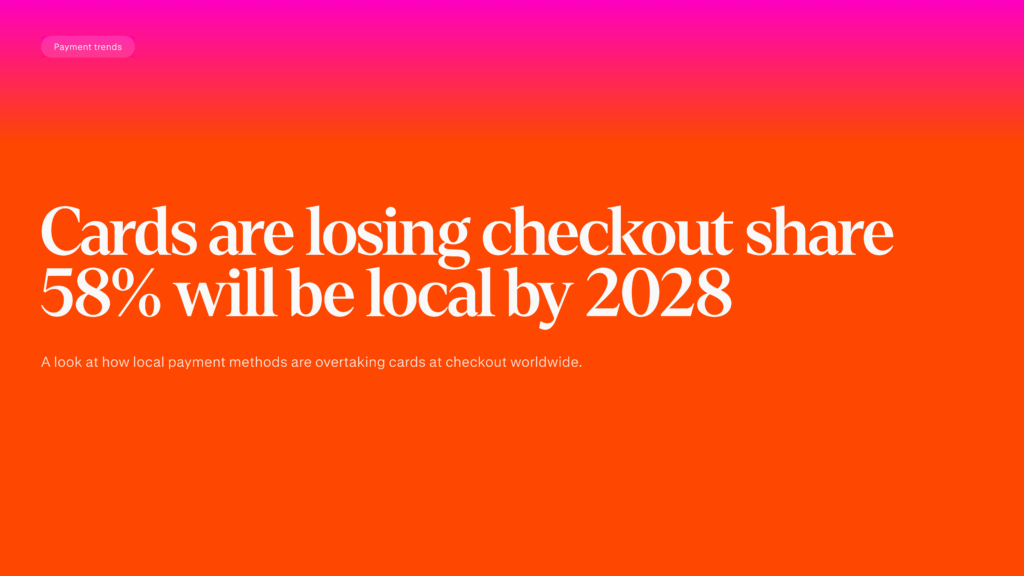
Cards have run the checkout page for decades. That run is ending. Digital wallets, account-to-account (A2A) transfers, direct carrier billing, and buy now, pay later (BNPL) are becoming the default way people pay online, market by market, not as a niche alternative but as the main event.
We tested that shift against the numbers in our Global Ecommerce Report, built with Juniper Research across 37 markets and 10,500 consumers. The data backs it up.
Key takeaways
- Cards’ share of e-commerce transaction volume falls from 41% to 30% by 2028.
- Local payment methods reach 58% of global e-commerce transaction value by 2028.
- A2A payments roughly double their share of transaction value, from 8% to 16%.
- Digital wallets, card-linked and otherwise, reach almost 56% of transaction value.
- Global e-commerce grows 65% by 2028, and none of that growth needs cards to lead it.
Cards aren’t disappearing. They’re just not leading anymore
Cards will keep growing in absolute terms as e-commerce expands. But leading a checkout page is different from being present on it, and cards are losing the lead. Volume share slides from 41% to 30% by 2028. Value share follows the same path, from 31% to 20%.
Europe shows how fast this can move once it starts. Card value share there drops from 44% to 23% in the same five years, as consumers shift to wallets and A2A rails built around how they already bank.
A2A is the clearest signal of where checkout is going
Account-to-account payments move money directly between bank accounts, no card required. Pix in Brazil and UPI in India already showed what happens when a market gets this right: adoption that outpaces anything cards have managed in the same window.
That pattern is now global. A2A’s share of e-commerce value doubles from 8% to 16% by 2028, and in several of the markets we surveyed, it’s already the most popular local payment method. This isn’t cannibalizing card spend. It’s bringing in payment behavior that didn’t exist at this scale before.
Wallets are where cards go to become invisible
Wallets, card-linked and non-card-linked combined, reach almost 56% of e-commerce transaction value by 2028. A lot of that is cards themselves, just tucked inside Apple Pay or Google Pay instead of typed out at checkout. The card doesn’t disappear. It just stops being the interface.
Non-card-linked wallets are moving faster still, plugging into local rails like Pix and UPI directly. The line between “wallet” and “A2A” is getting harder to draw, and that’s the point: payment methods are converging around whatever’s fastest and most familiar to the person paying, not around a single global standard.
There’s no universal checkout anymore
The strategic mistake merchants keep making is treating checkout as one decision instead of dozens. What clears in Brazil doesn’t clear in Indonesia. What converts in the Netherlands stalls in Saudi Arabia. Local preference isn’t a footnote to the payments landscape, it’s the landscape.
We connect merchants to 200+ local payment methods across 60+ countries through a single integration. Adding a market’s preferred wallet, A2A scheme, or carrier billing option shouldn’t mean building a new connection from scratch, and with us, it doesn’t.
The bigger picture
By 2028, local payment methods stop being the alternative and start being the default. Merchants still building checkout around a single global setup are optimizing for a market that’s already moved on.
For the country-by-country breakdown across Asia Pacific, the Americas, Europe, Africa, the Middle East, and the Indian subcontinent, the full Global Ecommerce Report: The Changing World of Payments has the detail behind every number above.