


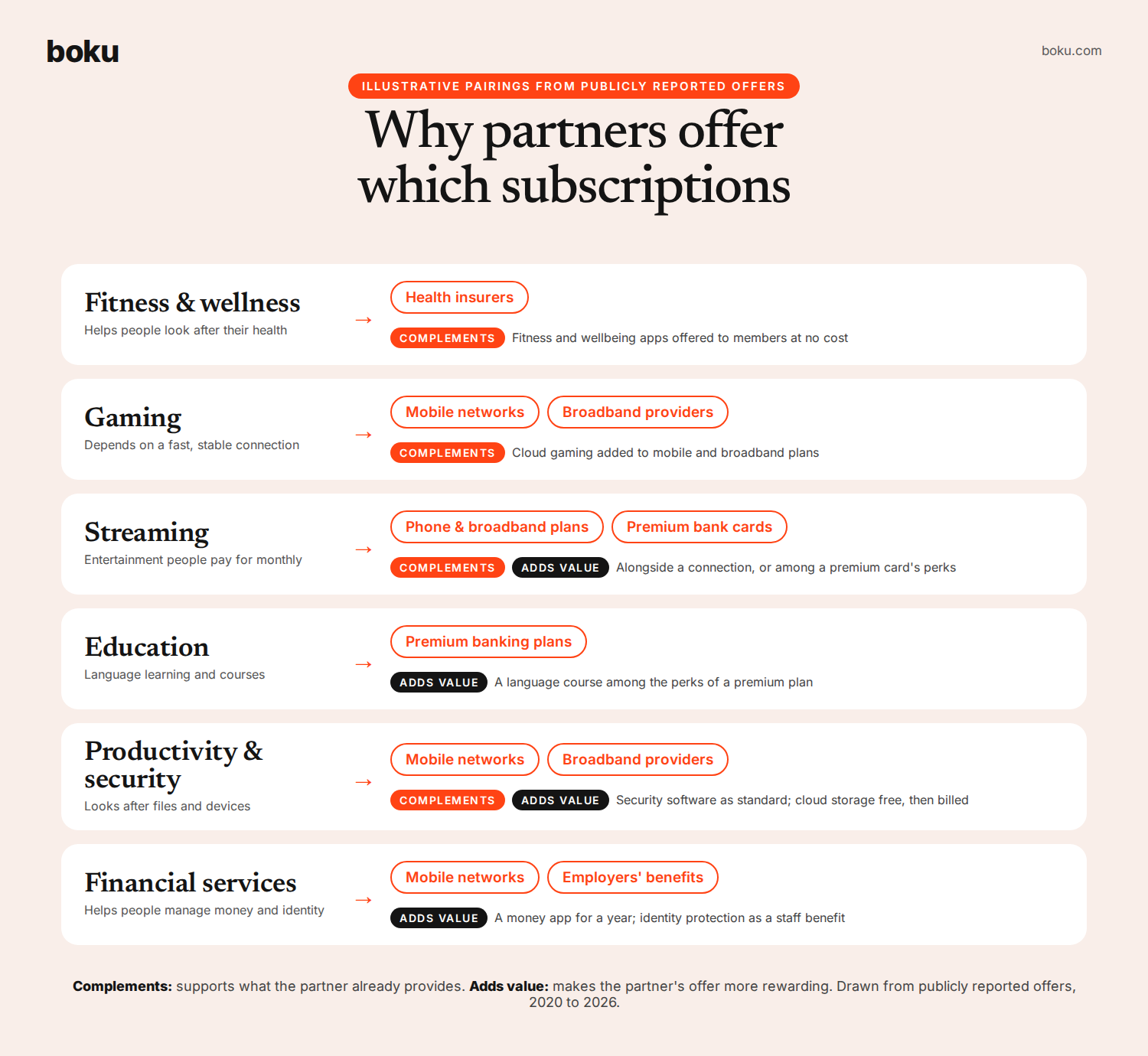
Publicly reported bundles across six categories show subscriptions fitting a partner’s offer in two main ways: they complement what the partner already provides, or they add value to the partner’s relationship with its customers. Examples range from cloud gaming on mobile and broadband plans to streaming among the perks of a premium bank card.Reported bundles show subscriptions complementing a partner’s service or adding value for its customersA fitness app, a gaming service, a streaming service, a language course, a cloud storage service and a money-management tool could each be offered through a partner. In every case, the partner needs a reason to include it. In the publicly reported bundles in this guide, the subscription fits the partner’s offer in one of two ways. Some subscriptions complement what the partner already provides, such as cloud gaming alongside a fast connection. Others add value to the partner’s relationship with its customers, such as streaming among a premium card’s perks. For each category, we look at how a real offer was set up and what the subscription brings to it. The examples are public announcements and offers, described without naming the companies, and they show what partners have offered. Whether each arrangement paid off isn’t public. Fitness partnerships with health insurers support members’ healthFitness and wellness apps help people look after their health, which sits close to what a health insurer covers. In 2021, a US health insurer offered a free year of a fitness subscription to members of its fully insured employer plans who owned a compatible smartwatch. Wellbeing apps have taken the same route. In 2020, another US health insurer made two mental-wellbeing apps available at no cost to its members in Washington state. In both cases, the app supports members’ health. Our guide to bundling partner trust looks at why that kind of connection matters to customers. Cloud gaming gives connectivity providers another service to offerCloud gaming depends on a fast, stable connection, which is what mobile networks and broadband providers sell. In 2023, a UK mobile network launched 24-month plans that bundled a laptop or smart TV with a six-month cloud-gaming membership. The same year, a Dutch fiber and mobile provider announced that its premium fiber and unlimited 5G customers would be able to add a cloud-gaming bundle from early 2024. For those customers, the subscription is something to use a faster connection for. Streaming has found a place on premium bank cards as well as phone plansPhone and broadband plans are a familiar home for streaming, where it sits alongside the connection people watch on. A premium credit card is a different case. In 2025, a US bank added complimentary video and music streaming subscriptions to the benefits of its premium credit card. For cardholders, streaming sits alongside the card’s other rewards as one more benefit. Our guide to subscription bundling for streaming covers the decisions that follow once a video service starts bundling. Edtech partnerships can sit among the perks of a premium planEducation subscriptions have been offered the same way. In June 2026, a digital banking app in Australia launched a premium plan that includes a language-learning subscription among 14 subscription perks, for a monthly or annual fee. Here the customer pays for the plan. Including a language course gives customers another benefit to consider when deciding whether the premium plan is worth paying for. Security software and cloud storage have reached customers through their connection providersSecurity software protects the devices and connection a broadband provider supplies. A UK broadband provider includes basic security software as standard for all its customers, and in 2025 added identity protection to its paid security upgrade, which customers can try free for three months. Cloud storage is less tied to the connection, and its example shows how a free period can lead to a paid one. In 2025, an Indian mobile network offered its pay-monthly and home broadband customers six months of a 100 GB cloud storage plan at no extra cost, claimed through the network’s app. The network said a monthly fee would then be added to the customer’s existing bill, and customers could choose not to continue. AI assistants are a related case with different economics, covered in our guide to bundling for AI subscription businesses. Fintech partnerships have reached customers through mobile plans and employee benefitsMoney-management apps help people keep track of their finances. In 2024, a UK mobile brand aimed at young people offered customers the chance to claim 12 months of a money-management app at no cost, with 30,000 promotional codes available. For customers who claimed a code, the app was a perk beyond their phone plan. Identity protection took a longer route: in 2022, a US insurer agreed to become the exclusive distributor of a digital security and identity protection service to employers, which offer it to their staff as a benefit. The service adds to the range of benefits the insurer can offer employers. Identity protection also sits between financial services and security, a reminder that these categories overlap.
Ask what reason a partner has to make your subscription part of its offerIn each example, the subscription either complemented the partner’s own service or added another benefit to its customer offer. The details varied from one partner to the next, from a perk included at no cost to a free period followed by a fee. For each of the six businesses at the start of this guide, the first question is the same: what reason does this partner have to make your subscription part of its customer offer? A partner with a clear answer deserves a closer look. FAQsWhat are some examples of subscription bundling? Publicly reported examples include a health insurer offering members a fitness subscription at no cost, a mobile network building cloud gaming into its plans, a bank adding streaming subscriptions to a premium credit card, and a digital banking app including a language-learning subscription in a premium plan. In each case, the partner offers the subscription to its own customers. Which partners suit a fitness or wellness app? Health insurers have offered both fitness and mental-wellbeing apps to members at no cost, and the apps support members’ health, which sits close to what insurers cover. Other partners can work too, depending on who your audience is and what reason the partner has to include your service. Are mobile networks the only partners for streaming bundles? No. Phone and broadband plans are a familiar home for streaming bundles, but they aren’t the only one. In 2025, a US bank added video and music streaming subscriptions to the benefits of its premium credit card, where streaming sits alongside the card’s other rewards. What are fintech partnerships in subscription bundling? They’re partnerships where a financial services subscription, such as a money-management app or identity protection, is offered through another company’s customer relationship. Examples include a UK mobile brand offering customers the chance to claim a year of a money-management app at no cost, and an insurer distributing identity protection to employers as a staff benefit. How do you find the right partners for a category not listed here? Ask what reason a partner would have to include your subscription. It may complement something the partner already provides, or give its customers another benefit. Then check whether the partner’s customers fit your service, using our guide to partner audience fit, before you approach it. Key takeaways |
|