


A cross-border subscription opportunity exists when people outside a streaming service’s home market have a reason to want its content. In each market, turning that interest into revenue depends on rights to the content it plans to offer there, a way for people to find it and pay for it (directly or through a local partner) and viable commercial terms.A streaming service’s potential audience can extend beyond its home marketAn established streaming business may find its home market growing more slowly after years spent building a recognizable brand and an audience for its content. Potential viewers may also live outside its home market, which is where a cross-border subscription opportunity can begin. People who have moved abroad, and others who keep a language or cultural connection to a country, may still look for its films, series and sport. Some may already know the service by name. That interest doesn’t turn into subscriptions on its own. The requirements vary between markets, but each one raises the same questions. Can the service offer its content there? Will people find it? Will the market be commercially viable? Language can shape which subscriptions people chooseFor some viewers, the connection is strong enough to influence what they pay for. In a 2024 survey of US viewers by Horowitz Research, reported by CTAM, 64% of Asian-language-dominant and bilingual viewers of Asian TV content said Asian-language content, or content aimed at Asian American audiences, was critical when choosing an entertainment subscription. Subscription packages are being built for audiences like this. In February 2025, one US streaming TV service launched a standalone package of an Indian broadcaster’s Hindi-language entertainment channels, at about $12 a month, aimed at Hindi-language TV viewers, The Desk reported. The survey shows why language matters to some viewers when choosing a subscription. The Hindi-language package shows how an established platform can serve a specific audience through its existing distribution.
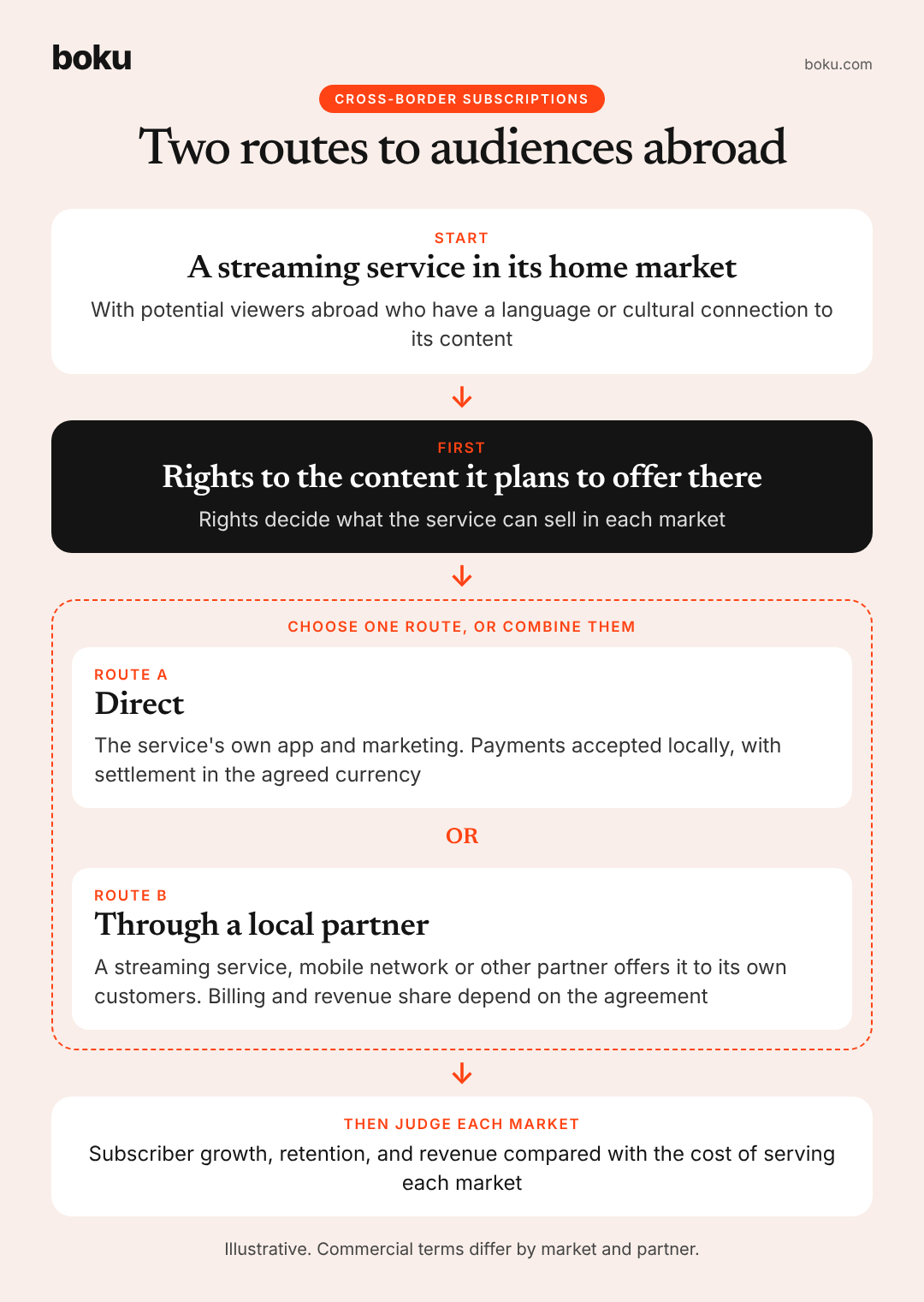
One Indian streaming service has served audiences abroad in two waysAn Indian streaming service shows how differently those audiences can be reached. In September 2026, it replaced its existing international app in the UK, Canada and Singapore with a new standalone service, carrying subscribers’ logins across. The relaunch was aimed particularly at the South Asian diaspora and at viewers interested in Indian languages and stories, Business Today reported. Its sports were left out of those markets because of existing content deals. In October 2026, the service took a different approach in the Middle East and North Africa, launching a dedicated destination within a regional streaming partner’s app and website. Its own sports weren’t included there either, but the destination is sold through the partner’s plans. One, at AED 49.99 a month, adds the partner’s own sports coverage, including cricket. Going direct, the service sells what its rights allow, under its own brand. Through the partner, it reaches the partner’s subscribers and sits alongside content it didn’t have the rights to offer itself. Audience size is only one test of a market abroadThat leaves the commercial question of which markets deserve the effort. A large, identifiable audience is a start. TechCrunch put the service’s potential audience across its three direct markets at more than 4 million people, based on Indian government figures. But, on its own, a large audience doesn’t make a market worth entering. The markets that are worth it are where identifiable demand, content the service can legally offer there and workable commercial terms come together. Those terms include what subscribers will pay, what local competitors charge, the cost of reaching people and, through a partner, the revenue split. A smaller market with an engaged audience, or a partner ready to sell, may offer a stronger commercial opportunity than a larger one that has to be built from scratch. Each route to subscribers abroad needs its own arrangementsOnce a market passes that test, the route decides the work involved. Selling directly means marketing in each market and offering payment methods people can use there. A viewer of Indian origin living in Canada is buying in Canada, so the service needs payment methods that work in Canada, including ones that renew automatically. The Indian service, for example, sells quarterly and annual plans priced in pounds, Canadian dollars and Singapore dollars. For businesses selling directly across several markets, Boku’s Online Payments connects them to more than 200 local payment methods across 60+ markets, including methods that support recurring payments, and settles the revenue collected. Where a business has wider cross-border needs, Boku’s Money Movement covers collection, currency conversion and settlement through licensed infrastructure in 40+ markets. Selling through a partner works differently. The partner brings its customers, its app and its plans, and who bills the customer and how revenue is shared depend on the agreement. Boku’s bundling platform links subscription businesses with partners, including mobile networks, banks and other subscription services, through one integration. Our guide to bundling for streaming services covers the terms to agree. The two routes can run side by side. The Indian service uses both in different markets, and another business might use both in the same one. Where interest abroad can become subscription growthFor a streaming business whose home market is slowing, international growth doesn’t always mean building an audience from nothing. People abroad may already know its content and have a reason to subscribe. Turning that interest into revenue depends on choosing those markets carefully, and on finding the mix of direct sales and local partners that suits each one. That gives an established streaming business a way to plan international growth around audiences with an existing connection to its content, using the distribution arrangements that make commercial sense in each market. FAQsWhat is a cross-border subscription opportunity? It’s the chance to win subscribers outside your home market among people who already have a reason to want your content, such as people living abroad or audiences with a language or cultural connection. Turning it into revenue depends on content rights, how people find the service, how they pay and whether the market’s economics work. How do streaming services reach audiences living abroad? Directly, through their own app in each market, or through a local partner such as another streaming service or a mobile network. One Indian streaming service sells its own app in the UK, Canada and Singapore, and reaches the Middle East and North Africa through a regional streaming service’s app. Does language affect which subscriptions people choose? It can. In one 2024 US survey, 64% of Asian-language-dominant and bilingual viewers of Asian TV content said Asian-language content, or content aimed at Asian American audiences, was critical when choosing an entertainment subscription. For a service with the right catalog, that’s an audience with a reason to look. How do you choose which international markets to enter? Look beyond audience size. Prioritize markets where identifiable demand, content you have the rights to offer and workable commercial terms come together, including what people will pay, local competition, the cost of reaching them and any revenue share with a partner. A smaller market with a ready partner may offer a stronger opportunity than a larger one that has to be built from scratch. Why do content rights matter for international streaming? Rights decide what a service can offer in each market. One Indian streaming service launched in the UK, Canada and Singapore without its sports, because of existing content deals. In the Middle East and North Africa, one partner plan adds the partner’s own sports coverage, which shows how a partner can fill a gap. How should subscribers abroad be able to pay? With payment methods that work where they live, including ones that support recurring payments. A viewer of Indian origin in Canada is buying in Canada. Revenue collected in local currencies then needs converting where necessary and settling where the business wants it. |
Key takeaways
|