


Key takeaways
- A first bundling partnership proves the model. Scaling across partners and markets requires repeatable integration, standardized operations, and centralized reporting that grows with the portfolio rather than against it.
- Integration is only one part of the scaling challenge. Commercial negotiations, reconciliation, lifecycle management, and performance reporting all add maintenance and operational overhead as partner count grows.
- Without consolidated reporting, it’s hard to know which partnerships are performing, which offers are converting, and where to invest next. Most teams spend significant time just standardising data before they can begin to read it.
- Scaling subscription bundling partnerships requires integration, offer management, operations, and reporting to work together rather than as separate processes.
The first partnership proves the model. Scaling it is a different challenge.
For most subscription businesses, the first bundling partnership follows a familiar path. A commercial agreement that takes longer than expected, a technical integration that runs over timeline, and then a live partnership that performs well enough to justify the investment.
The partnership demonstrates that mobile operator distribution has commercial potential, so the commercial case for doing more becomes clear.
It is at this point the organization decides to scale. And that’s where the friction starts.
Why each new partner takes longer than the last
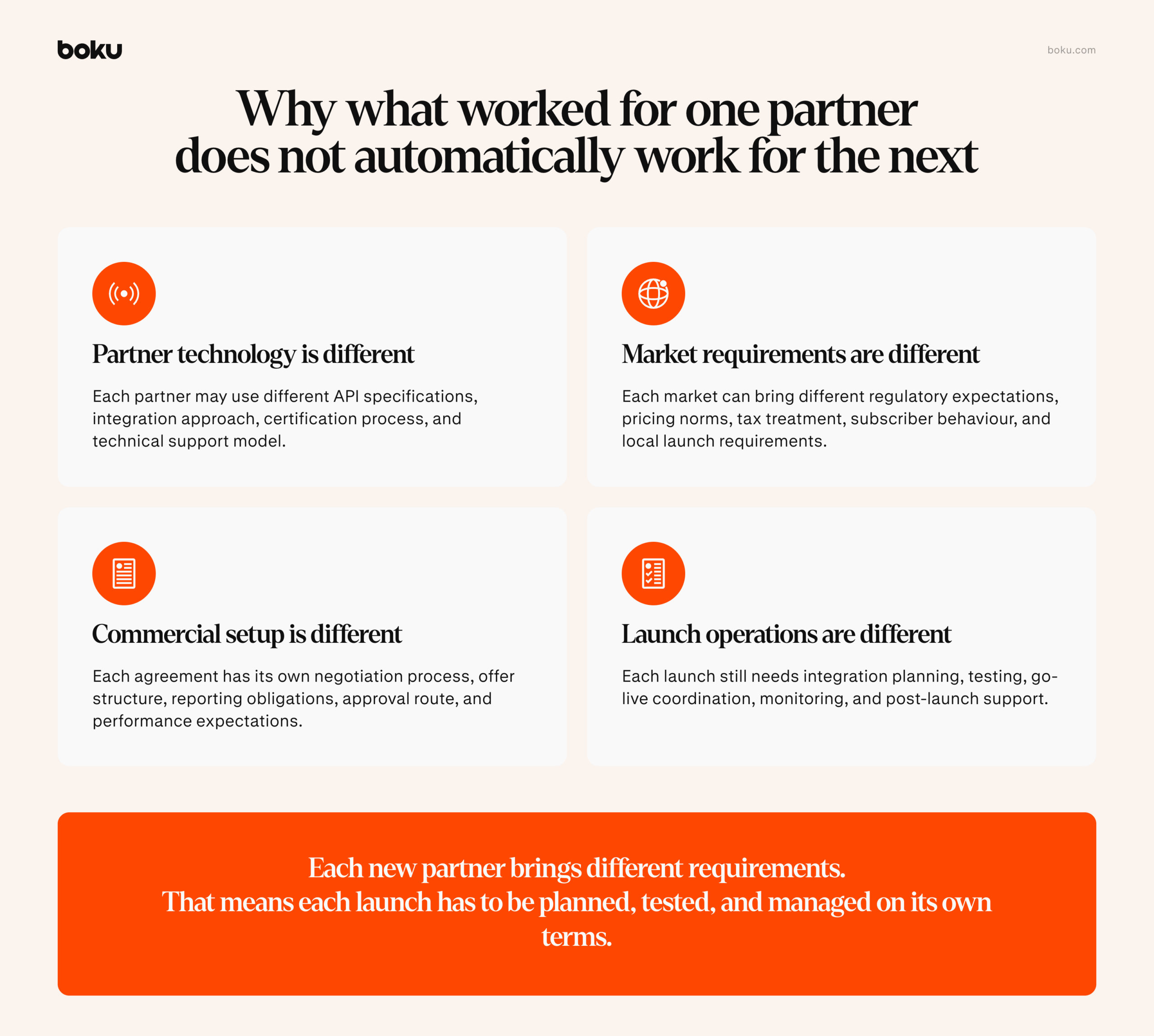
The integration challenge is the most visible part of the scaling problem. Building a direct connection to a bundling partner is not a small task.
The onboarding process for each partner typically involves:
- Coordinating the end-to-end project with the partner
- Creating the solution design
- Testing and certification, including basic API and connection testing
- Handling any technical changes the partner wants to make after go-live
Then there’s the ongoing maintenance as post-launch partner support adds another layer of operational cost that grows with each new relationship in the portfolio.
For a single flagship partner, that investment is justifiable. For a second, third, and fourth partner, each requiring its own onboarding process and ongoing support, the cumulative engineering and delivery cost becomes an obstacle. Teams that were fully occupied building the first integration are still maintaining it while trying to start the next one.
| ~6 months typical time to build a direct partner integration from scratch | weeks average time to launch when integration infrastructure is already in place |
The operational and maintenance overhead that builds after launch
Going live with a partner is the beginning of an ongoing relationship that demands consistent attention across offer changes, pricing updates, promotional campaigns, reconciliation, and performance reporting.
Each of those tasks is manageable for one partner. Across five or ten partners in multiple markets, the cumulative maintenance and operational overhead becomes a serious strain. Reconciliation alone requires aligning subscription data and partner reporting across systems that were never designed to talk to each other. Failed renewals and subscription edge cases multiply with partner count.
Launching in multiple regions simultaneously is possible, but it means running multiple partner projects at the same time, each with its own setup, coordination, and go-live requirements. For most subscription teams, absorbing that workload while continuing to build new features and improve the core product is the real constraint. Each new market compounds the operational cost rather than sharing it.
The reporting gap that makes it hard to know what’s working
Performance data is the final piece of the puzzle, and often the most neglected. When partnerships are managed independently, every partner sends reporting in a different format, with different line items and different definitions of the same metrics. Before a team can even begin to read the numbers, they’re spending hours standardising and reconciling data from different sources.
That makes it genuinely difficult to answer basic commercial questions:
- Which partners are driving the highest activation rates?
- Which offers are converting best in which markets?
- Where is churn highest, and what is causing it?
- Which partnerships are worth investing more in, and which have plateaued?
Without a consolidated view across all partners, these questions require manual effort to answer and the answers are often incomplete. Commercial decisions about where to invest next get made on instinct rather than data.
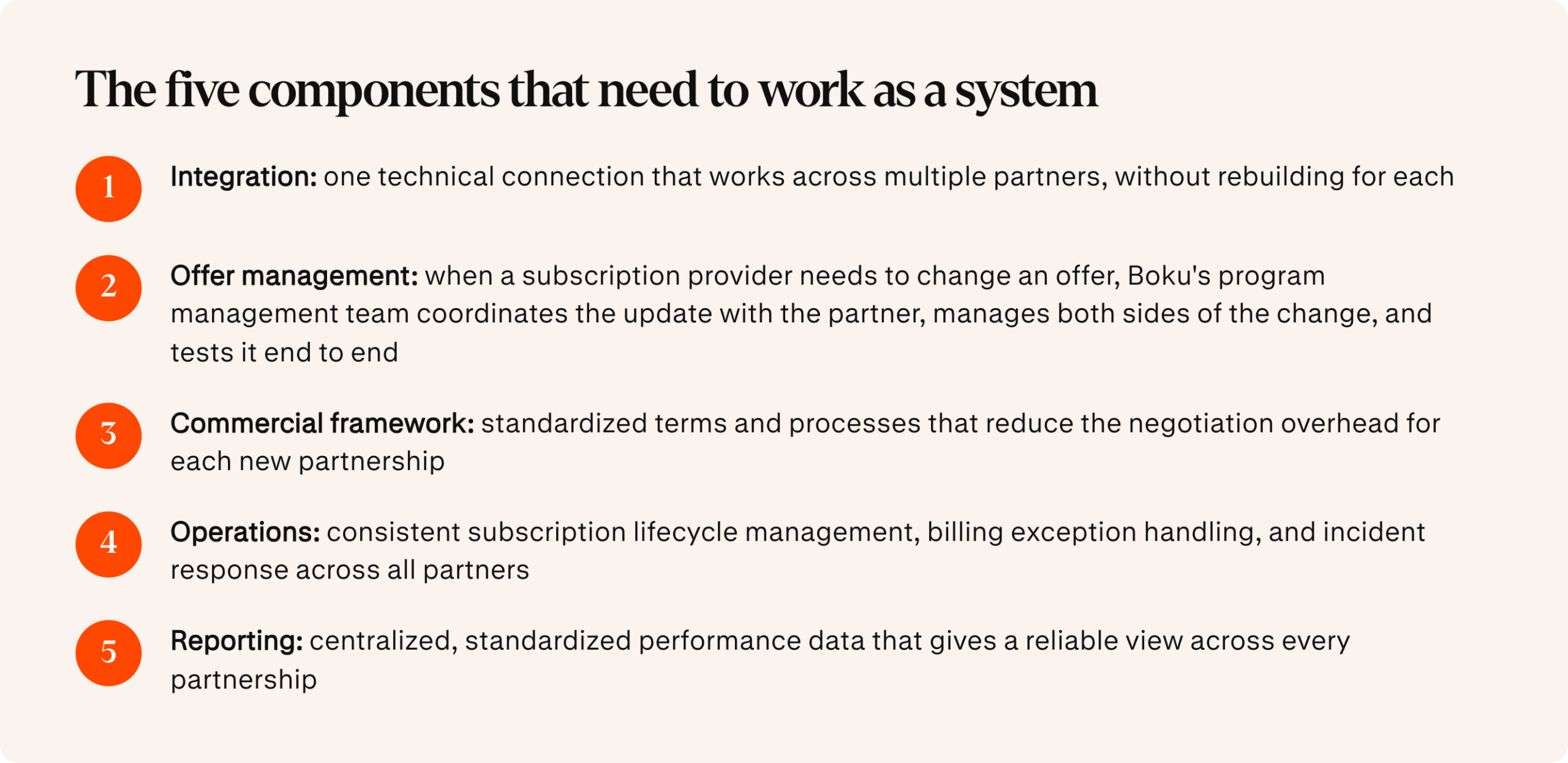
This is why scaling subscription bundling partnerships requires more than a faster integration. Offer management, operations, and reporting need to work as part of the same system, not as separate workstreams added on after the fact.
Repeatability separates programs that plateau from programs that scale
The subscription providers that have built bundling into a reliable growth channel share a common trait. They solved the repeatability problem first.
Repeatability means that the operational and maintenance processes for onboarding partner 15 are the same as those used for partner 5. Each new partner is still different, with its own market, its own requirements, and its own nuances, but the team isn’t building a new operating model each time. The delivery process, performance reporting, and incident response all follow an established pattern.
That matters most for the partnerships with the highest commercial stakes, such as large user bases, high activation volumes, or tight reliability requirements. The subscription businesses that pursue those partnerships with confidence do so because their operational model has already been tested at scale.
The next post in this series looks at the commercial question that sits alongside the operational one: whether to own your partner relationships directly, or to distribute through a reseller or marketplace model, and what that choice means for long-term growth.
FAQs
Why is scaling subscription bundling partnerships so difficult?
Each new bundling partner requires its own separate integration, commercial agreement, and operational processes for lifecycle management and reporting. The maintenance overhead doesn’t stay constant as the partner count grows. Without a repeatable model for integration and operations, the cost and time required to add each new partner increases, and the capacity to manage existing ones gets stretched.
How long does it take to launch a telco bundling partnership?
A direct integration with a telco or non telco partner typically takes several months to complete, covering onboarding coordination, solution design, API and connection testing. Where a subscription provider already has standardized integration infrastructure in place, that timeline can be reduced significantly, with some launches going live in weeks rather than months.
Can a subscription business launch bundles in multiple regions at the same time?
Parallel launches across multiple regions are possible, but they require significant resource and project capacity to run simultaneously. Each market brings its own setup, coordination, and go-live requirements. For most subscription teams, the constraint isn’t technical feasibility — it’s whether they can absorb that workload while continuing to build their core product. Subscription providers that manage this successfully typically have a standardized operational model that reduces the setup effort for each new market.
How do you negotiate bundling deals at scale?
Every distribution partner agreement involves its own negotiation, alignment process, and sign-off. Commercial terms like revenue share and minimum subscriber guarantees vary by partner and market: minimum guarantees depend on a partner’s subscriber base, so they’re never a consistent number across deals. Subscription providers that scale their partner portfolio successfully tend to develop structured commercial processes that reduce the time required for each new negotiation, without removing the flexibility to adjust terms by partner.
What does a scalable bundling operational model look like?
A scalable bundling model treats integration, offer management, commercial processes, operations, and reporting as a connected system rather than five separate workstreams. The goal is that adding a new partner applies an existing model to a new context, rather than building new processes from scratch. Offer changes are coordinated centrally, performance reporting is standardized across all partners, and the maintenance and operational overhead per partnership stays manageable as the portfolio grows.