

| A distribution partner network is the set of companies that offer your subscription to their own customers. Telcos are one of the biggest routes, but banks, digital wallets and retailers can do it too. Choosing the right mix comes down to two questions: who does each partner reach, and how do its customers buy? |
A distribution partner network can reach well beyond telcos
When building a distribution partner network, telcos are one of the biggest routes to new subscribers. Deloitte predicts that 25% of online video subscriptions globally will be sold via telcos by 2028, up from 20% in 2023.
Banks, digital wallets and retailers can offer your subscription as well.
But more options can make the decision harder. To find the partners that reach the people you want, ask two questions about each one: who does it reach, and how do its customers buy?
Distribution partners reach people through different everyday relationships
Put to different partner types, these two questions result in different answers:
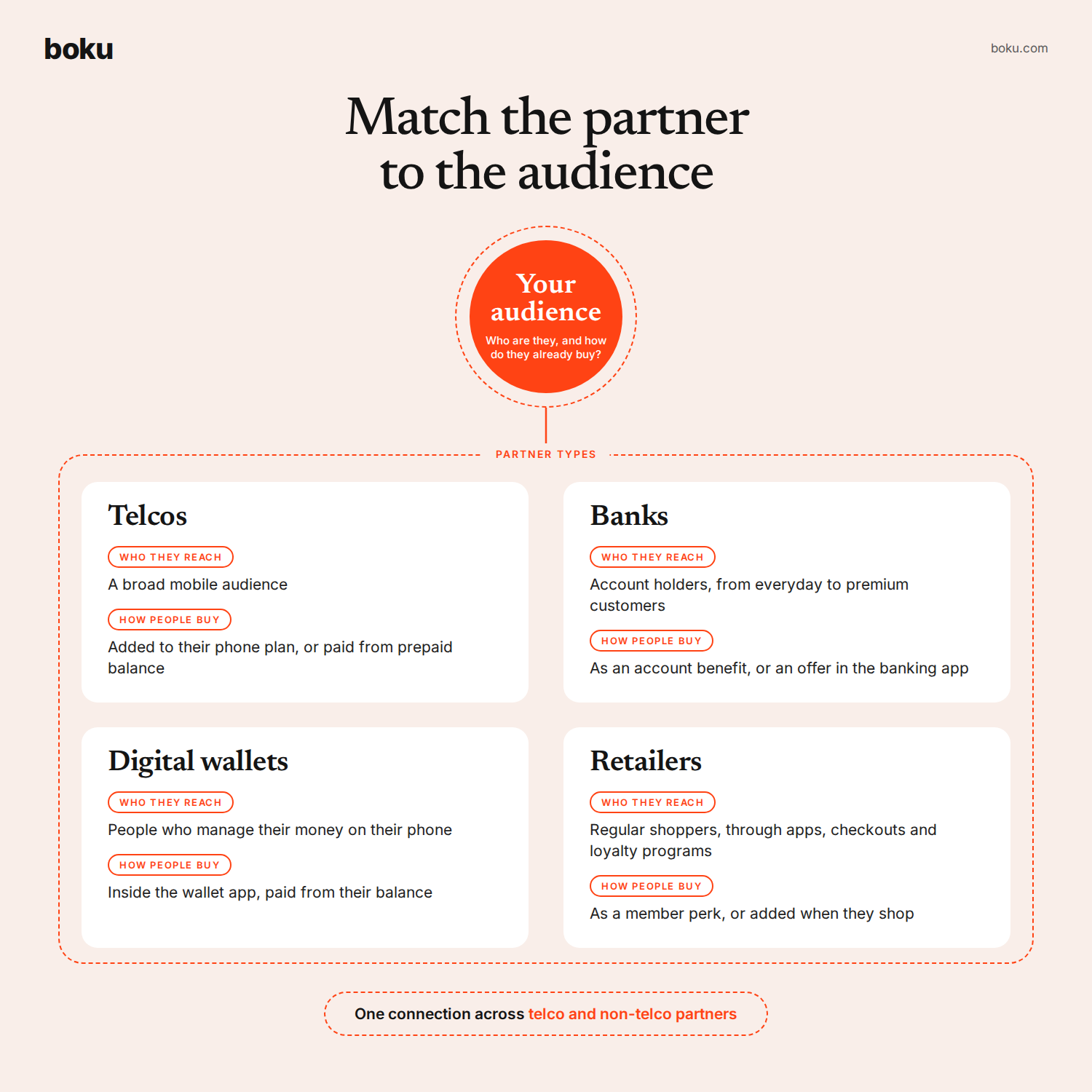
- Telcos reach a broad mobile audience. Customers can add the subscription to their phone plan, pay for it from their prepaid balance or get it included in their plan.
- Banks reach account holders, from everyday customers to people who pay for a premium account. A subscription can come as an account benefit, or as an offer inside the banking app.
- Digital wallets reach people who manage their money on their phone, and in markets where wallets are common, that audience is large. Mobile money wallets alone had 593 million accounts active in a 30-day period in 2025, according to the GSMA. Customers buy inside the wallet app and can pay from their balance.
- Retailers reach regular shoppers through their apps, checkouts and loyalty programs. Deloitte’s 2025 loyalty survey found that US loyalty program members belong to eight programs on average and actively use five. A subscription can be offered as a member perk or added when someone shops.
What changes from one type to the next is who the relationship is with, and this decides who your subscription reaches.
To build your distribution partner network, start with your own audience
Now ask the same two questions of your own subscribers: who are they, and how do they already buy?
Your own data is an obvious place to start. Where your current subscribers live, which devices they use and how they pay can help narrow the kinds of partner relationships worth investigating. Look for brands which already share your ideal customers.
Used as examples, the answers can point to a first shortlist of partner types:
- If a large share of your subscribers already pay you with a digital wallet, wallet partners may be worth looking at first.
- If your audience is broad and mostly uses your service on mobile, telcos may reach more people like them.
- If they already pay for premium banking, a bank’s account benefits may suit your service.
- If they’re households that buy groceries every week, a retailer’s loyalty program may put you in front of them.
From there, the work moves on to comparing individual partners within each type.
Mixing telco and non-telco partners can reach more of your audience
The same person can have several of these relationships at once, such as a phone plan, a bank account and a favorite retailer, meaning a useful shortlist can span more than one partner type.
This is why a mix of partners can reach more of your audience than any single one, so long as each partner adds people the others don’t. Before you commit, it’s worth determining what each partner adds, using the method described in how subscription businesses find their next million subscribers.
Be aware, a partner network can also create more technical work if each partner needs a separate connection. With Boku, one connection works across multiple telco and non-telco partners, so adding a bank or a retailer after a telco needs less new technical work. How partners share this kind of setup is covered in our guide to partner ecosystems for subscription businesses.
The right distribution partner network starts with who you want to reach
This blog started with a question: with more partners to choose from today, which ones will reach the people you want? The answer is that it depends on your audience.
Telcos remain a strong route to mobile customers, and for some audiences they may be all you need. For others, a bank, a wallet or a retailer may add audiences a telco doesn’t reach. By starting with who you want to reach and how they already buy, you’ll take a path more likely to lead toward the right mix.
FAQs
| What is a distribution partner network? It’s the group of companies that offer your subscription to their own customers, such as telcos, banks, digital wallets and retailers. This is known as subscription bundling. Customers sign up through a relationship they already have with the partner, and the partner handles the billing. The mix of partners in your network decides which audiences you can reach.
What’s the difference between telco and non-telco distribution partners? Telcos offer your subscription through a phone plan or prepaid balance, and reach a broad mobile audience. Non-telco partners, such as banks, digital wallets and retailers reach people through a bank account, a wallet app or a loyalty program. Each reaches a different mix of people, so one partner network can include both.
Are telcos still good distribution partners for subscription businesses? Yes. Telcos reach a broad mobile audience, and Deloitte expects their share of online video subscriptions to keep growing through to 2028. They’re one option among several, so start with who you want to reach before deciding which partner type to approach first.
How do you know which partner types fit your audience? Ask of each partner type who it reaches and how its customers buy. Then ask the same of your own subscribers, using your data on where they live, which devices they use and how they pay. Where the answers overlap, you have a partner type worth shortlisting.
Do you need a separate integration for each type of partner? It depends on how you connect. Building directly with each partner can mean a new integration every time, and different partner types can work in different ways. With Boku, one connection works across multiple telco and non-telco partners, so later partner launches need less new technical work. Key takeaways
|