


| Involuntary churn is the loss of subscribers whose payment fails, even though they wanted to keep paying. After a price rise, every subscriber who stays is worth more to you and is harder to replace, so each of these losses costs more. You reduce involuntary churn by recovering failed payments, and by selling through partners who bill customers and handle failed payments for you. |
After a subscription price increase, losing subscribers unintentionally costs more
When you raise prices, some subscribers will decide your service isn’t worth the cost to them anymore and they’ll cancel. It’s an expected consequence of an increase.
Those who stay are a different story. They’ve seen the new price and decided to keep paying. So losing one of them because their card expired is a double loss: the revenue you planned on, and the customer who’d otherwise still be with you.
This is involuntary churn. There’s no complaint from the subscriber and no exit survey so it’s easy to miss. It also lands in the same churn figure as cancellations, so unless you report the two separately, a payment problem can look like a pricing problem.
The good news: it can be fixed by improving how payments are collected.
Why subscription payments fail and how businesses recover them
Payments fail for everyday reasons: an expired or replaced card, not enough money in the account on the day, a bank fraud check that flags a repeat charge, or out-of-date billing details.
Some failures are temporary (soft declines), and retrying later can work. Others are final for that card (hard declines), and the customer needs to give new details.
Recovering them is known as dunning management. It usually combines timed retries, reminders to update details, a short grace period and card update services, which some card networks offer. Your payment success rate (the share of payment attempts that go through) and recovery rate (the share of failed payments you recover) show how well it’s working.
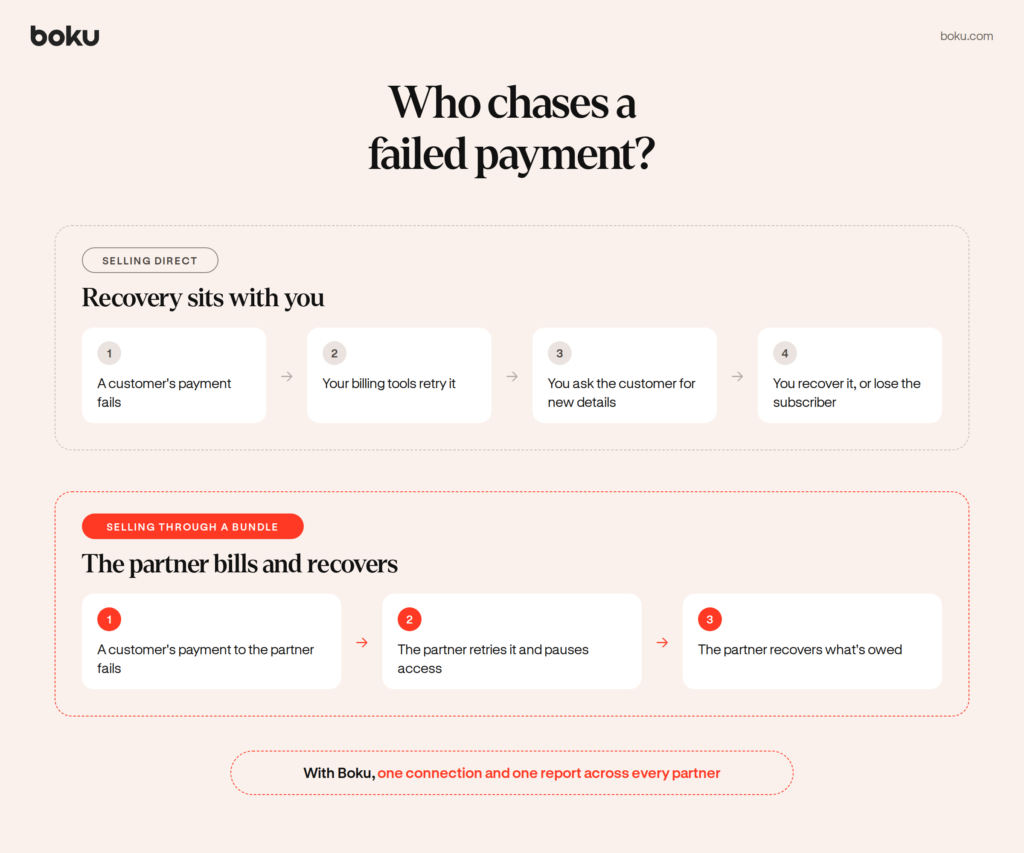
If you sell direct, your billing platform or payment provider usually runs this for you.
Subscription bundling can move failed payment recovery to the partner
In a subscription bundle, your service comes as part of a partner’s package (e.g. a mobile plan, or a bank account). Your subscriber pays the partner, on a bill they already receive.
This changes who collects the money. The partner bills your subscriber and handles what happens when a payment fails: retrying it, pausing access and recovering what’s owed.
For you, that’s one less recovery process to run for those subscribers.
Adding partners makes failed payments harder to track.
Each one runs its own billing system and reports failed payments, suspensions and cancellations in its own way. Without one view across them all, it’s hard to tell whether a drop in subscribers is a payment problem, and if so, where.
With Boku, you connect once and work with every partner the same way. One report matches up billing records between you, each partner and Boku, so everyone works from the same numbers. Our support team deals with issues across partners and markets, so you’re not chasing each one on your own.
What to look for in a bundling partner when payments fail
Whether you work with partners directly or through a bundling platform, ask these questions before you launch:
- Who bills the customer, and who chases a failed payment? Get a clear answer on retries and grace periods.
- How long does the customer keep access while a payment is being recovered? Cutting access too early can turn a short delay into a lost subscriber.
- How are failed payments and suspensions reported to you? You need them broken out by partner and market.
- Do the partner’s numbers match yours? Ask how billing records are checked between you, the partner and anyone in between.
- Who’s responsible when something breaks? Know who owns an incident and how fast they respond.
- How much extra work does the next partner create? If each one brings its own billing setup and reports, failed payments get harder to track as you grow.
For wider ways to keep subscribers (pause options and win-back offers, for example), see our blog, ‘Subscription retention strategies.’
FAQs
| What is involuntary churn, and how is it different from voluntary churn? Involuntary churn is when a subscription ends because a payment fails and isn’t recovered, even though the subscriber wanted to stay. Voluntary churn is when a subscriber decides to cancel. They should be dealt with separately: better offers and pricing for voluntary churn, and failed payment recovery for involuntary churn. Report them separately so you can see which one is moving. What causes involuntary churn? Involuntary churn starts with a failed payment. Common causes include an expired or replaced card, not enough money in the account on the day, the bank declining the charge (sometimes because its fraud checks flag a repeat payment) and out-of-date billing details. If nothing recovers the payment in time, the subscription ends. What’s the difference between a soft and hard decline? A soft decline is a payment that fails for a temporary reason, like not enough money in the account on the day or a short-term problem at the bank. Retrying later can work. A hard decline is final for that card (it’s expired, canceled or the account is closed), so the customer needs to give new payment details. What is dunning management? Dunning management is the process of recovering a failed subscription payment. It usually means retrying the payment at set intervals, messaging the customer to update their details and giving a short grace period before access stops. The aim is to keep the subscription running while the payment gets sorted out. How do you measure involuntary churn? Count the subscribers lost because a payment failed and wasn’t recovered, as a share of all subscribers over the same period. Track it alongside your payment success rate (the share of payment attempts that go through) and your recovery rate (the share of failed payments you win back). In a bundle, you’ll need these figures from each partner, in the same format. What causes involuntary churn? Involuntary churn starts with a failed payment. Common causes include an expired or replaced card, not enough money in the account on the day, the bank declining the charge (sometimes because its fraud checks flag a repeat payment) and out-of-date billing details. Some failures are temporary and can be fixed by retrying. Others need the customer to give new payment details. How does bundling affect failed payment recovery? In a bundle, your subscriber pays the partner (a mobile operator or bank, for example), and the partner handles billing, retries, suspensions and recovery. That means you don’t run recovery for those subscribers yourself. As you add partners, failed payments become harder to track, so it helps to get the same reporting from every partner.
Key takeaways
|