


| Partner audience fit is how closely a partner’s customers match the people most likely to value, buy and keep using your subscription. A large audience is less useful if few of them fit your service, because the headline number doesn’t show how many sign up, start using it and stay. Judge fit before launch, then check audience quality after it. |
A partner’s audience size tells you little until you know how many of those people fit
A partner pitch can open with a big number, such as millions of customers or millions of active users. It’s a natural place to start, and they’re easy numbers to share internally.
That number includes people who may have little interest in a service like yours. So look for how many of them fit your service. That’s partner audience fit (how closely a partner’s customers match the people most likely to keep using what you offer).
Two partner audiences show how a bigger number can mislead
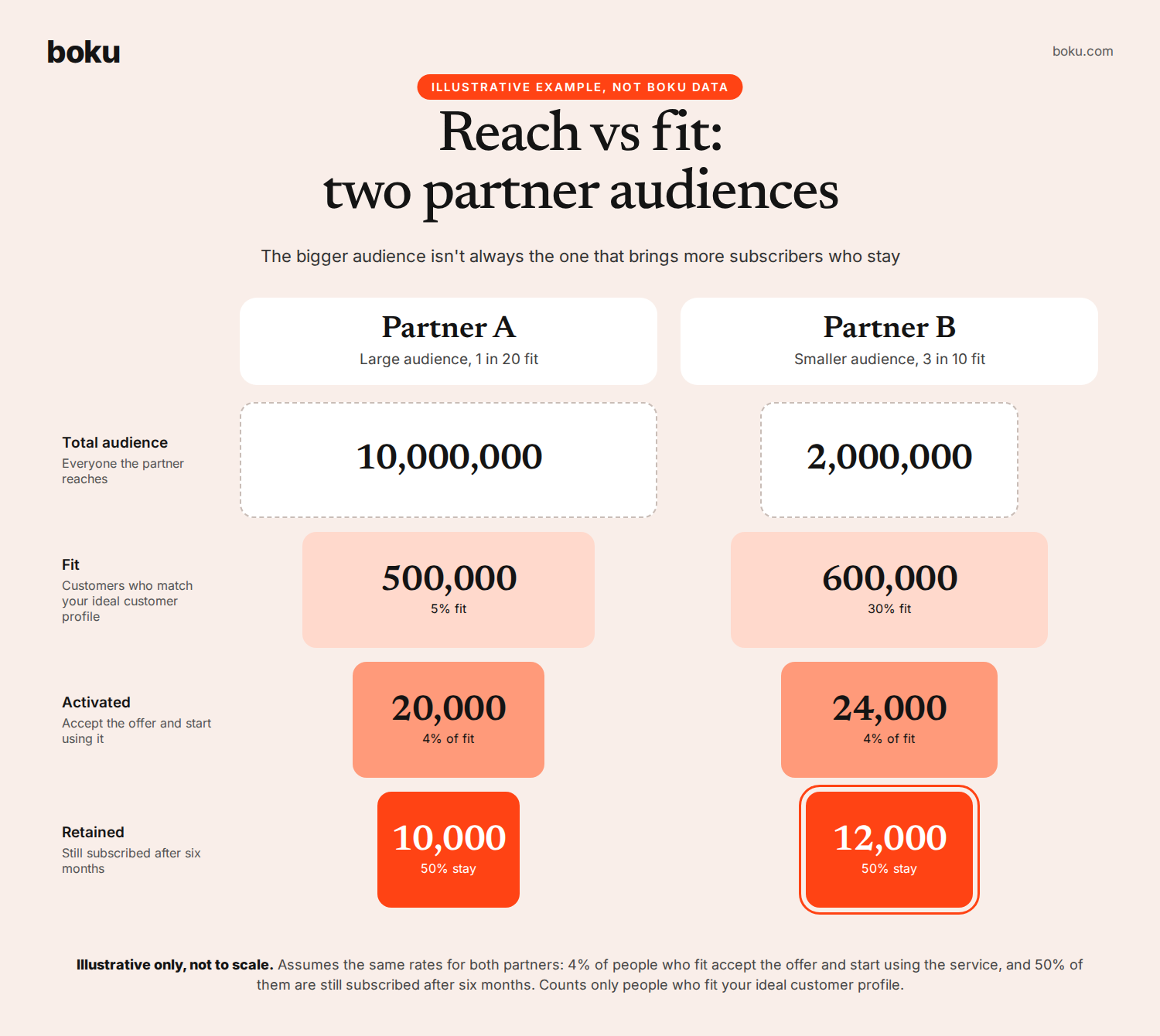
Take two partners. Partner A has 10 million customers, and about 1 in 20 of them match your ideal customer profile. Partner B has 2 million customers, and about 3 in 10 do.
That gives Partner A 500,000 people who fit and Partner B 600,000. Now apply the same rates to both: 4% of those people accept your offer and start using the service, and 50% of them are still subscribed six months later. Partner A ends up with 10,000 retained subscribers, and Partner B with 12,000.
These figures are illustrative, and the example leaves out anyone who doesn’t fit. But with every later rate held equal, Partner B still finishes ahead because more of its audience is relevant from the start.
Before launch, judge partner audience fit against your ideal customer profile
To tell a Partner A from a Partner B before launch, you need something to compare each audience against. Ideal customer profile describes the people most likely to buy your service and keep using it, based on your current subscribers and who you want to reach.
With that profile in hand, ask each partner for an aggregated picture of its customers, and compare it on three things:
- Who they are, such as where they live, their age and their life stage
- What they already pay for, such as similar digital services or premium tiers
- How they use the partner, such as how often they open its app or visit its stores
Ask what the audience picture is based on, too. Some partners draw on records of what their customers actually do, while others rely on estimates or surveys. Records tend to be more reliable, so weigh the overview with that in mind.
Audience fit is one input among several when you choose a partner, alongside commercial terms and readiness, covered in our guide to choosing distribution partners.
After launch, activation and retention tell you more about audience quality than sign-ups alone
Once a partner is live, sign-ups are easy to track, but sign-ups alone can mislead. In a 2019 analysis of subscriber data from three US newspapers, Northwestern University’s Medill Spiegel Research Center found that how often subscribers read local news was the single biggest predictor of whether they stayed.
That analysis covers news subscriptions but it illustrates the importance of what happens after sign-up. For a partner channel, three measures give you a clearer picture of audience quality:
- Activation: how many people who accept the offer go on to start using your service
- Continued use: how many keep using it over the first few months
- Retention: how many are still subscribed at set points, such as three and six months
The value comes from measuring them consistently. Track the same measures for every partner, at the same points after launch, so you can compare audiences on the same basis. Boku’s reporting tracks activations and retention across multiple partners in one view, which makes those comparisons easier to run.
Partner audience fit turns a big number into a useful one
The headline audience number shows the size of the opportunity. How many of those people fit, and how many of them stay, tell you how much of it is likely to count.
Each partner you launch also shows you more about who signs up, uses the service and stays. That sharpens the ideal customer profile you judge the next audience against, and our guide to finding your next million subscribers shows how to size the audiences that pass the test.
FAQs
| What is partner audience fit? Partner audience fit is how closely a partner’s customers match the people most likely to value, buy and keep using your subscription. It looks at who those customers are, what they already pay for and how they use the partner. A high fit means more of the partner’s headline audience is likely to be relevant to your service. What is an ideal customer profile? An ideal customer profile is a description of the people most likely to value, buy and keep using your service, informed by your current subscribers and the audiences you want to reach. Subscription businesses can use it to judge partner audiences before launch, then refine it as each partner shows who signs up, uses the service and stays. Is a bigger partner audience always better? No. Reach shows the size of the opportunity, but a large audience is less useful if few of those people fit your service. A smaller partner whose customers closely match your subscribers can bring more of the people you want. How do you measure audience quality after launch? Track activation (how many people who accept the offer start using the service), continued use and retention at set points, such as three and six months. Use the same measures and timings for every partner so the comparisons are fair, and feed what you learn back into your ideal customer profile. What’s the difference between audience quality and reach? Reach is how many people a partner can put your offer in front of. Audience quality is how many of them fit your service and, once you’re live, how many sign up, start using it and stay. Reach shows the size of the opportunity, and quality shapes how much of it is relevant. |
Key takeaways
|