


- About: One of the world’s largest streaming and content businesses, with a portfolio spanning streaming, broadcast, and content brands across North America and Europe.
- Products used: Bundling
- Industry: Streaming and digital content
- Regions: US, Europe, Africa
- Use case: Bundled distribution at scale across telco, retail, and delivery partner
Key takeaways
- One integration gave the streaming business a repeatable way to add distribution partners without rebuilding the core connection each time. Boku can connect new partners to the platform as opportunities arise, rather than limiting the business to a fixed partner catalogue.
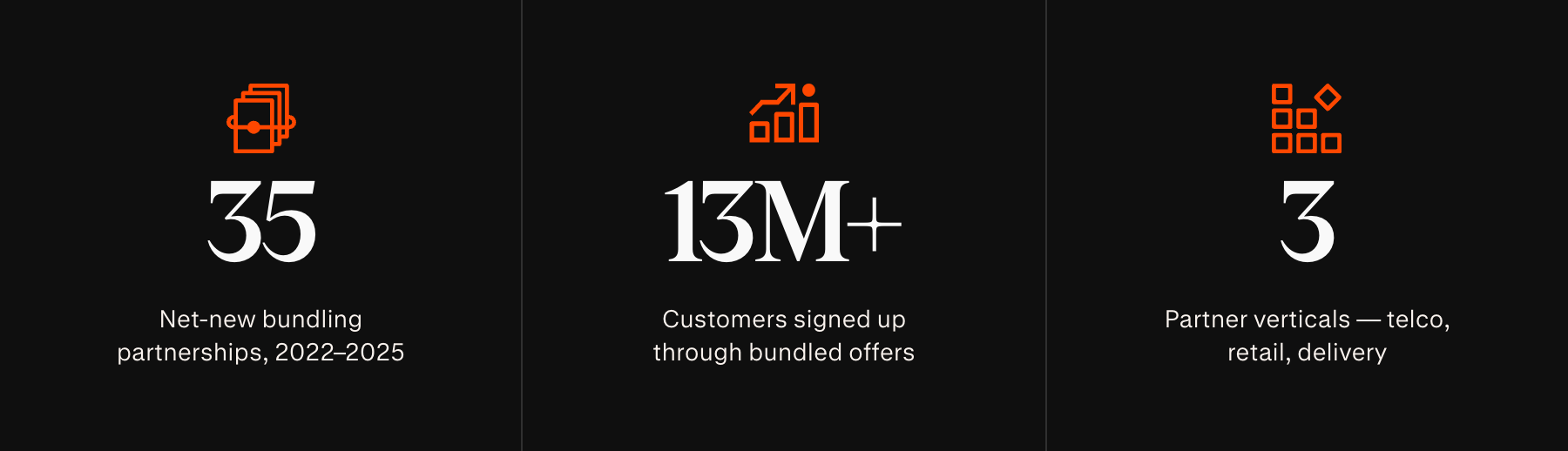
- The streaming business added 35 net-new partnerships between 2022 and 2025, with more than 13 million customers signing up through bundled offers. Each launch reused the same technical foundation, helping turn bundling into a scalable subscription growth channel.
- Expanding beyond telco into retail and delivery opened additional acquisition channels through services already part of customers’ daily lives, giving the streaming business more ways to reach potential subscribers.
- Standardized reporting gave the team a consistent view of performance across partners and offers, making results easier to evidence to senior leadership and supporting clearer decisions about where to invest next.
The streaming business kept control of its direct partner relationships, offer structure and commercial decisions, while Boku handled the technical and operational work needed to scale the program.
One of the world’s largest streaming businesses wanted to scale partner distribution across the US, Europe, and Africa. Early telco partnerships had already proven the commercial value of bundling, bringing in subscribers faster and at lower cost than direct-to-consumer acquisition alone. But scaling through bespoke partner integrations was becoming increasingly time-consuming and complex. The team needed a way to expand its partner portfolio while retaining control of its relationships, offers and roadmap. Through a single Boku integration and commercial agreement, it added 35 net-new partnerships across telco, retail and delivery between 2022 and 2025, with more than 13 million customers signing up through bundled offers.
The challenge
Direct integrations proved the model. Scaling it was the hard part.
One of the world’s largest media and entertainment streaming brands set out to build a partner distribution network that could scale across the US, Europe, and Africa. Early telco partnerships had proven the commercial case, and the brand wanted to expand on it.
Scaling that model through bespoke partner integrations was the problem. Every new partner arrived with its own APIs, billing flows, entitlement logic, and reporting formats. Each connection added ongoing technical and operational work, pulling teams away from developing and launching the next partnerships on the roadmap.
As the portfolio grew, the operating burden grew with it. Reporting was fragmented across partner-specific formats, so the team had no single view of which bundles, price points, and partner types drove activation and retention. Reconciliation, lifecycle edge cases, and partner-specific incident management stacked up, and decisions about where to invest next had to be made without the data to support them.
The team ruled out a reseller route. For a brand in a competitive, fast-moving market, keeping direct commercial control of each partner relationship mattered more than the convenience of a third-party catalogue. In the team’s judgment, letting a catalogue decide partner selection and sequencing would have been a step backwards. They needed a model that carried the operational weight of partner-by-partner expansion while keeping the strategy and the relationships in their own hands.
The solution
One integration, one agreement, control of the roadmap.
We gave the streaming business one platform and one commercial agreement with us to launch and grow bundling partnerships worldwide. We built the model around their business so they could decide which partners to pursue, which markets to prioritize, how offers appear, and how commercial terms are structured. They keep control of their direct partnership without the operational burden of building every connection themselves.
On the engineering side, the team integrated with us once. That one integration opens access to the partners we connect to, while we manage the partner-specific onboarding, technical setup, and delivery for each launch. A new partner or market no longer meant another custom integration from scratch for the streaming company’s engineers. The model is built to support multiple launches at once.
Because Boku can connect new partners without requiring them to implement the full platform, the network can expand quickly to almost any local distribution partner the subscription business chooses. That gives the team faster access to best-fit audiences in each market and more flexibility over where to grow next.
The moment partners are live, we keep supporting performance. Standardized reporting dashboards across partners give the team insight into which bundles, price points, and partner types drive activations and retention. Our account management team brings market and competitive insight into the conversation, while performance data helps inform decisions about future offers.
The results
35 bundling partnerships launched across three continents through one integration
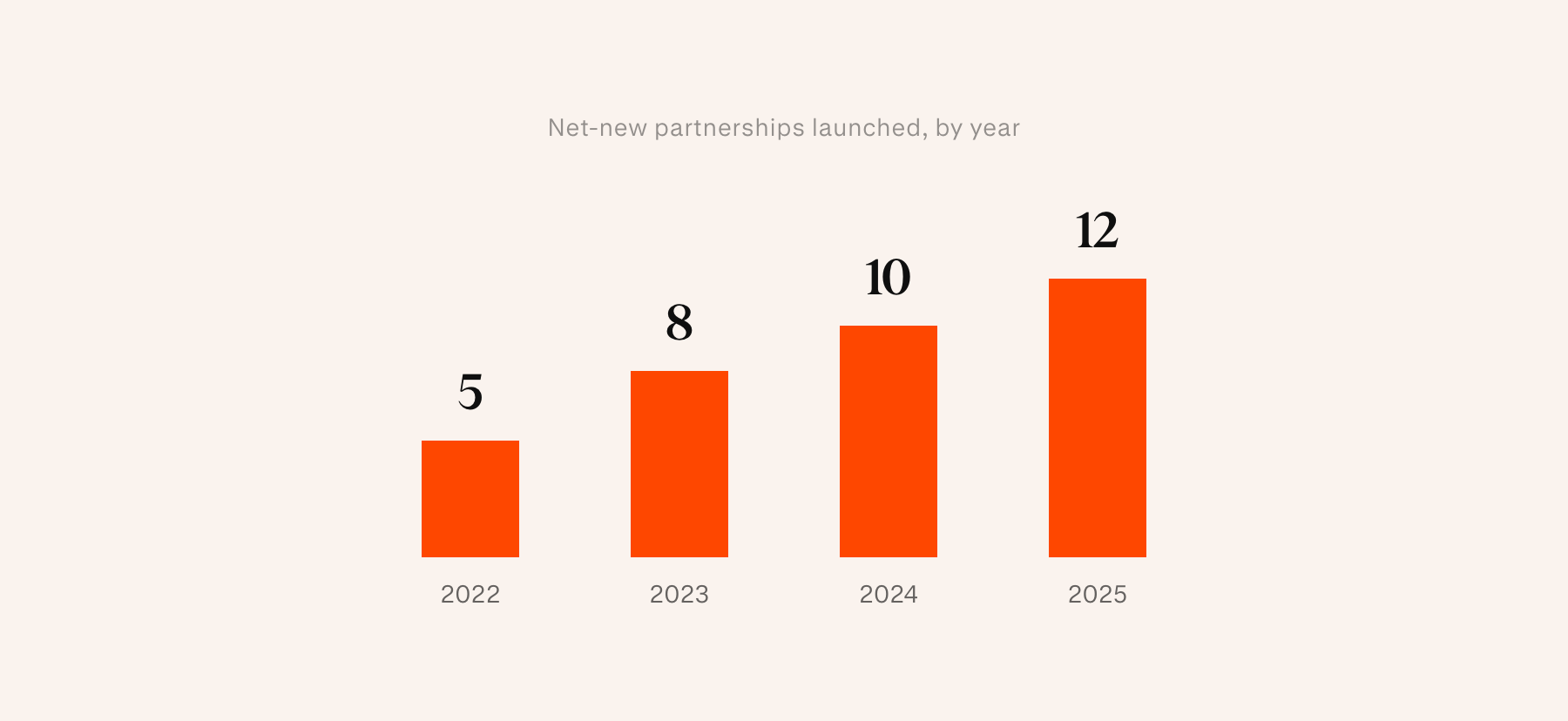
The first partners went live in 2022, with 5 launched that year and 8 the next. The pace then picked up, with 10 new partnerships in 2024 and 12 in 2025 to give 35 net-new bundling partnerships between 2022 and 2025. Because each launch reused the same integration and the same agreement with us, adding a partner didn’t mean rebuilding the core integration each time.
The program also diversified across channels. What began with telco grew, with us, into retail through a leading US membership program and into delivery through a major on-demand grocery service. Those local partners brought established audiences and first-hand knowledge of local markets, purchasing behaviour and customer preferences, helping the streaming business reach people through channels already trusted in each market. The streaming business could reach potential subscribers through trusted services already part of customers’ daily lives, with every launch reusing the same integration and the same agreement with us underneath.
Across the period, more than 13m customers signed up through the bundled promotional offers. What mattered was the quality of the partner mix as much as the count: distribution relationships with local reach and access to the audiences the brand wanted to reach.
FAQs
How did the streaming service manage 35 bundling partnerships without a custom build for each one?
The streaming business integrated with Boku once. That single integration could then be reused as new distribution partners were added to the platform, while Boku managed the partner-specific onboarding, technical setup and delivery for each launch. Instead of rebuilding from scratch every time, the team had a repeatable model that could support multiple partner launches in parallel.
Why didn’t the streaming service use a reseller platform?
The streaming business wanted to keep direct control of its partner relationships, offer structure and commercial terms. With a reseller model, adding a distribution partner outside the existing network can require that partner to go through a lengthy enterprise buying and implementation process. With Boku, new distribution partners can connect with a light integration, giving the streaming business greater flexibility over who it works with and when. Boku also provides performance insight to support the growth of its partner channel.
How did the streaming service scale its bundling program between 2022 and 2025?
Boku managed the partner-specific onboarding and delivery behind each launch, while the same core integration supported multiple launches across different markets in parallel. As the model proved itself, the streaming business had the confidence to keep expanding its partner roadmap, adding 35 net-new bundling partnerships by the end of 2025. The approach was designed specifically to avoid launches having to happen one after another.
What partner verticals did the streaming service reach through Boku?
The program began with telco partnerships and expanded into retail through a leading US membership program and delivery through a major on-demand grocery service. Boku’s partner-agnostic platform is designed to support a broad range of distribution partners, including telcos, financial services, wallets and commerce platforms, rather than limiting subscription businesses to one partner type or a fixed catalogue.
How does Boku’s reporting help subscription businesses manage a growing partner portfolio?
Boku brings reporting from different distribution partners into one place, giving subscription businesses a consistent view of performance across markets, partners and offers. The reporting includes metrics covering areas such as activations, churn and retention, helping teams understand what is working and use that evidence when deciding which offers, partners and markets to pursue next.