


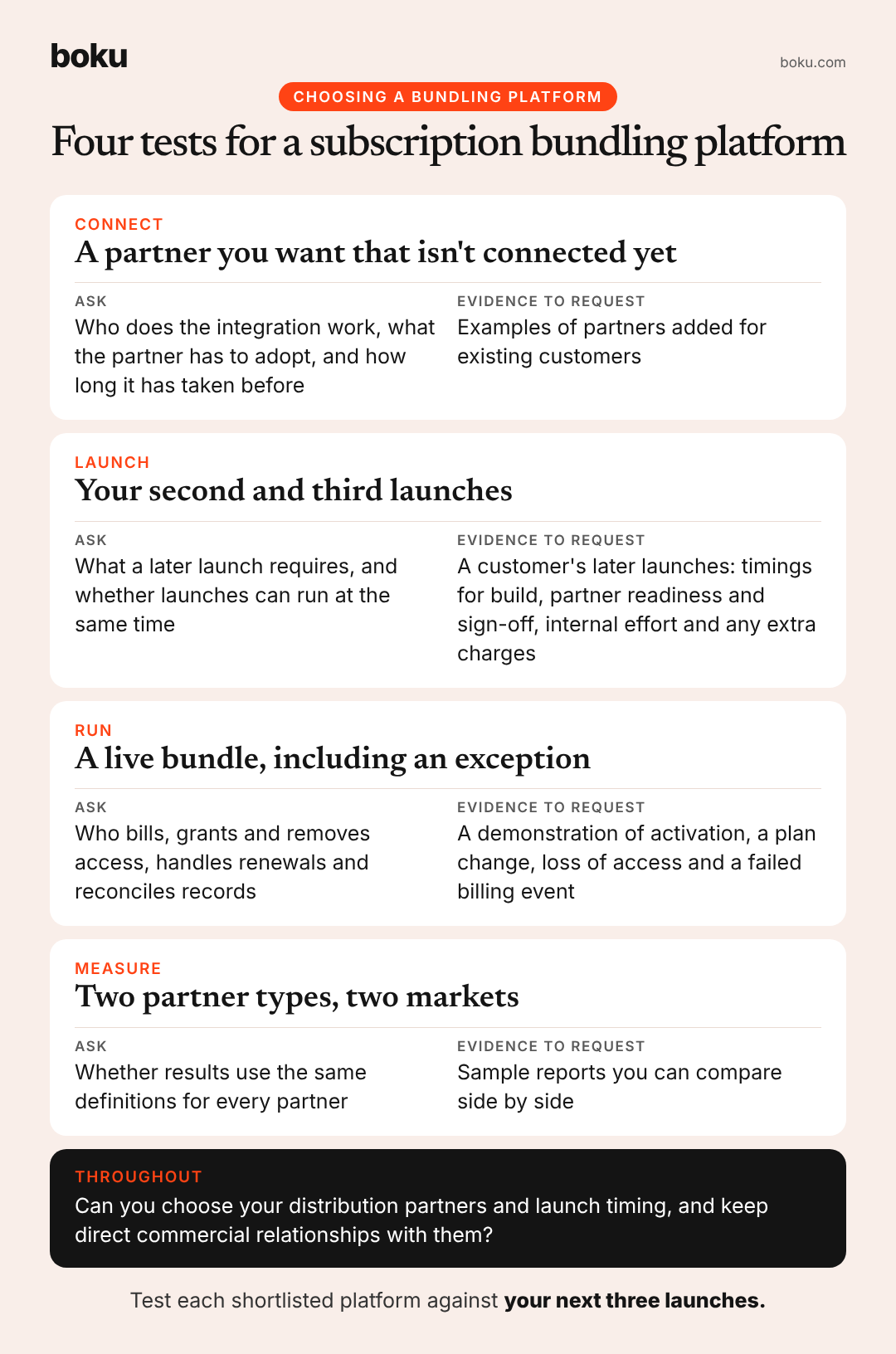
To choose a subscription bundling platform, test it against the partnerships you plan to run, beyond the first launch. Ask each provider to show how it connects a partner that isn’t on its network yet, what each later launch requires, who handles billing, access and exceptions, and how results compare across partners and markets.
A subscription bundling platform can look convincing when a provider demonstrates a first launch that shows one partner, one market and a team following every step. It doesn’t show what happens when the business adds new partner types or launches in several markets. A solution that supports one successful partnership may not suit a program that spans several, so test it against the program you intend to run.
That means asking each provider for evidence, including demonstrations, sample reports and examples from businesses that have run several launches over time.
Start with the partnerships you plan to run
A business can combine approaches. It can hold direct commercial agreements with its distribution partners and still use a platform for the technical connection, operations and reporting, or work with a provider in one region and its own team in another.
Before speaking to providers, list the next three launches you expect: the partner types, the markets and the offers. That list becomes the test each shortlisted platform has to pass, and it’s also the basis for estimating cost of provider fees, any charge for connecting a new partner and the internal time each launch would take.
The list is important because work that’s acceptable once can become a burden when it repeats. Why scaling subscription bundling partnerships is hard looks at how that effort builds as partners are added.
How does the platform connect a new distribution partner
A provider can show the partners it already works with. That coverage matters, and it’s worth separating the partner types and markets that are live today from those that are planned.
The more revealing question is what happens when the next partner on your list isn’t connected. Who does the integration work on the partner’s side, what does the partner have to adopt or buy, how long has it taken before and what does it cost you?
In Boku’s case study of one streaming business, the business integrated with Boku once and added 35 new bundling partnerships between 2022 and 2025, rising from five in the first year to 12 in the last, including a retail membership program and a grocery delivery service alongside mobile networks. Boku handled each partner’s onboarding, and the case study demonstrates how Boku can connect new partners without requiring them to implement its full platform. That’s one customer’s experience, and it’s the kind of evidence to request from any provider – partners added over several years, and how each was connected.
What each launch after the first requires
Once a new partner can be connected, the next question is how much of that work must be repeated for the one after. An existing customer can say their second launch requires new development on their side, new testing, a new agreement with the provider and any extra charges. It also relevant whether launches with different partners can run at the same time.
Timings are more useful with their parts separated. The technical build, the partner’s own readiness and the commercial sign-off move at different speeds, and a provider controls only part of that.
Who handles each step of a live bundle
As more partners go live, their billing arrangements and subscription processes have to stay manageable. Who bills the customer, who grants and removes access, who handles renewals and who reconciles the records depends on the arrangement, and it can differ from one partner to the next.
A demonstration shows how that works in practice with a customer activating, changing plan and losing access, plus an exception, such as a failed billing event or a mismatch between a partner’s records and yours. How the exception is caught and resolved shows more than the routine flow does.
Compare partners and markets on the same measures
When partners use different reporting formats and definitions, comparing their performance takes extra work, and decisions about which partnerships to expand get harder. Sample reports covering two partner types and two markets show whether a provider applies the same definitions throughout.
On Boku’s bundling platform, conversion, churn and subscriber growth are tracked across every partner, so a mobile network and a retailer can be read side by side. Our article on how subscription businesses use data to manage and grow bundling partnerships covers how to use that reporting.
Check who decides which partners, markets and launch order
A platform may support a wide range of partners without letting the subscription business pursue any commercially suitable partner on its own timetable. Where the provider decides which partners are available, or in what order launches happen, the program follows the provider’s priorities.
It is therefore good to establish whether you choose the partners, markets and sequence, including partners the provider doesn’t work with yet. Boku’s bundling platform is built around that choice; the subscription business picks the partners, markets and launch order.
Ask each provider for evidence against your next three launches
By the end of the evaluation, each shortlisted provider should have shown how it would connect the partners on your list, what each launch after the first would require and cost, how a live bundle and its exceptions are handled and how results would be reported. Technical suitability is one part of the decision, and our guide to choosing a bundling technology partner covers whether you can rely on the provider and its terms.
Testing each platform against your planned launches gives you a firmer basis for the shortlist, built on what each provider has shown and what your expansion is likely to cost.
FAQs
What is a subscription bundling platform?
A subscription bundling platform connects a subscription business to distribution partners, such as mobile networks, banks and retailers, so its service can beincluded in their offers. It handles the technical connection, the flow of activations and changes between systems, and reporting. Who bills the customer depends on the arrangement with each partner.
How does a bundling integration work?
The subscription business connects its systems to the platform, and the platform connects to each distribution partner. Once a bundle is live, activations, plan changes, cancellations and billing events pass between them, and records are reconciled. A platform is designed so later partners reuse the first integration, so ask what each new partner still adds.
How long does it take to launch a bundle with a new partner?
It depends on the technical build, the partner’s readiness and the commercial agreement, which move at different speeds. Ask providers for timings with those parts separated, and for examples from existing customers’ second and later launches, including the internal effort and any extra charges each one involved.
What should a bundling platform report on?
Activations, conversion, churn and subscriber growth, broken down by partner, market and offer, using the same definitions for every partner. Consistent reporting is what makes it possible to compare a mobile network with a retailer, or one market with another, and decide which partnerships to expand.
Should you build bundling partnerships in-house?
Some businesses run direct integrations with each partner, and this can work for a small number of partnerships. As the program grows, each new integration adds build, testing and operating work. Estimating the effort and cost of your next three launches under each option shows where a platform makes sense.
Key takeaways
- Test a subscription bundling platform against the partnerships you plan to run, beyond the first launch.
- Ask what happens when the partner you want isn’t connected yet, and who does that work.
- Ask for a demonstration of a live bundle, including an exception such as a failed billing event.
- Check that reporting compares partners and markets on the same definitions.