




If cancellations rose after your last price increase, raising prices again is only one way to increase ARPU, your average revenue per user. First decide whether you need more revenue from each subscriber or more revenue overall, because add-ons, cheaper plans, annual plans and partner offers each help with one, the other or both.
A price rise trades some subscribers for more revenue from the rest
You’ve raised prices twice in 18 months, and cancellations went up both times. Revenue still needs to grow, but before a third price rise, knowing how to increase ARPU in other ways is advantageous.
Firstly, price rises can still pay off. In 2022, a large streaming service told shareholders it had a net loss of about 600,000 paid memberships in the US and Canada in one quarter, largely because of a price change, yet the change remained “significantly revenue positive”. A quarter later, it said the rate at which members were canceling, though still slightly higher, was back near its level before the price change.
A large US mobile network made the same trade in early 2025. Its price rises were expected to bring in more than $1 billion in extra revenue, RCR Wireless reported, and its chief revenue officer said: “I’ll do that trade off any day, but it created elevated churn for us in Q1.”
The other side of the trade shows up in what subscribers say. In the UK, Ofcom found in 2025 that the most common reasons people gave for unsubscribing from or downgrading streaming services were to do with cost, and 23% of those who had left one large service in the previous three months named its higher price.
These are reasons people report, so they can’t measure how many cancellations one price rise causes, but they point to two responses: leaving or moving to a cheaper plan.
Decide whether you need more revenue per subscriber or more revenue overall
Average revenue per user (ARPU) is your revenue divided by your average number of paying subscribers. One large media company counts subscription fees, advertising, and premium and add-on features in that revenue, after discounts on offers that combine several services.
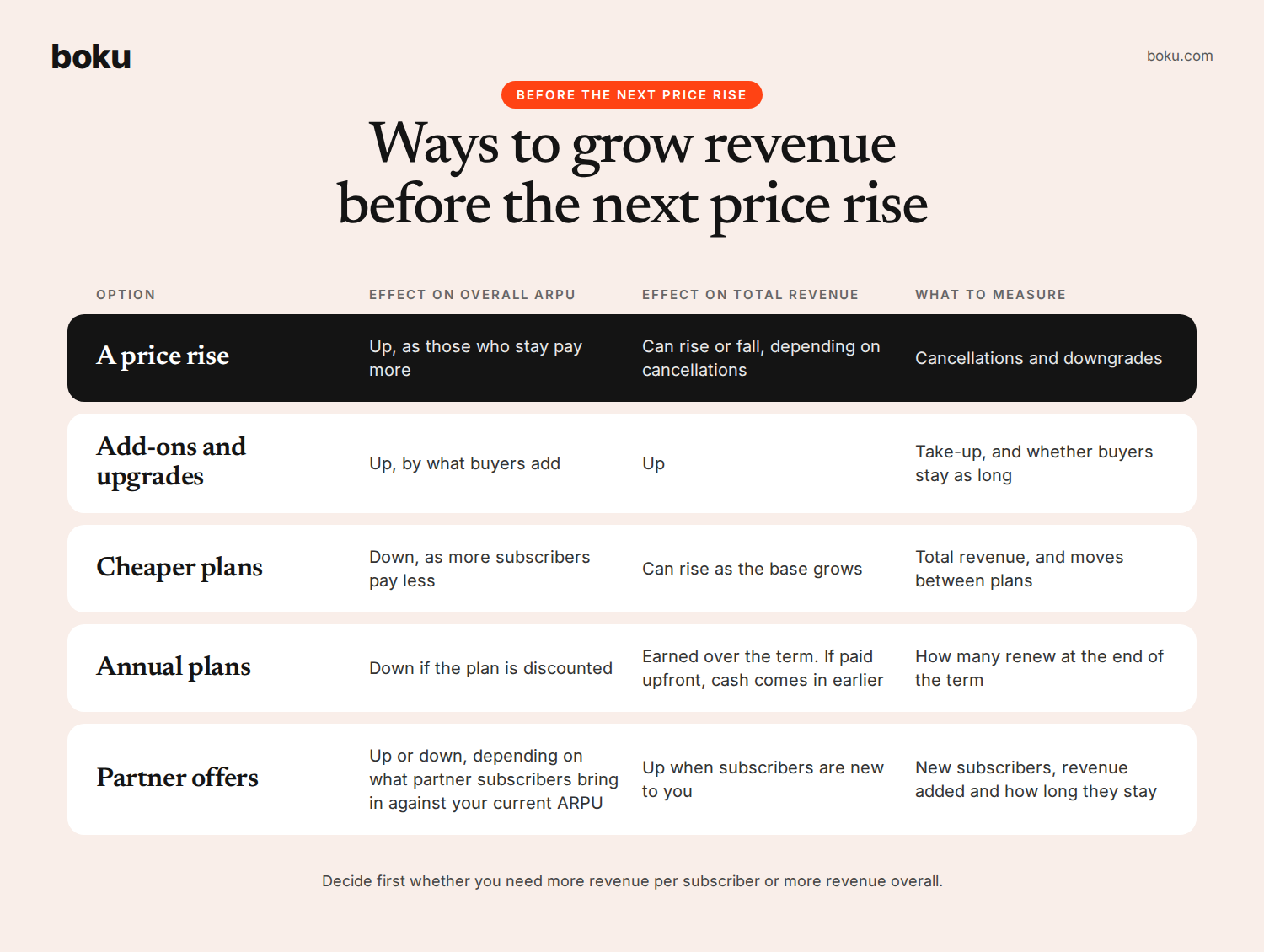
Raising ARPU and growing total revenue are different goals. An upsell can raise both, a cheaper plan can grow total revenue by adding subscribers while lowering the average, and a partner offer can do either.
So for each option below, ask how it changes revenue per subscriber, how many subscribers it could add or cost you, and what you’d measure to judge it. How long subscribers stay is similarly vital, which our Guide to Subscriber Lifetime Value covers.
Add-ons and upgrades increase revenue from subscribers who want more
Add-ons charge more only to the subscribers who choose them, so they raise revenue per subscriber without a price rise for everyone. The mobile network above had sold its customers 7 million add-on perks, at an average of $10 each, according to the same RCR Wireless report.
To judge whether add-ons are working, track how many subscribers buy them, and whether those buyers keep their subscription as long as everyone else. If buyers cancel sooner, the extra revenue may not make up for what you lose.
Plans at different price points can grow total revenue while lowering the average
A cheaper plan, such as one with advertising, lowers what those subscribers pay, so ARPU can fall even as the base grows. In the last quarter of 2024, the same streaming service said its ads plan accounted for over 55% of sign-ups in the countries where it was offered, describing it as a way to offer lower price points.
It can also bring in advertising revenue, give subscribers somewhere to move up from, and give those who might cancel after a price rise somewhere cheaper to go. Measure total revenue, and how many subscribers move up to, or down from, your other plans.
Annual plans trade a discount for a year’s commitment
Annual plans paid upfront bring cash in earlier and secure payment for the agreed term, subject to your cancellation and refund terms. The revenue itself is earned over the term, as you provide the service. A discount lowers what each subscriber pays per month, and independent evidence on whether annual subscribers stay longer after the year is limited.
Measure how many renew at the end of the term, and make the commitment and cancellation terms clear when subscribers sign up.
Partner offers can grow total revenue by adding subscribers
A bundle with a mobile network, bank or retailer brings in subscribers at a rate agreed with the partner, without raising the price for subscribers you already have. Whether it lifts or lowers your ARPU depends on how that rate compares with your current ARPU, and it adds nothing to your base when subscribers simply switch from paying you direct.
Measure the new subscribers it brings, the revenue they add and how long they stay. For the kinds of partners that have offered subscriptions, see our subscription bundling examples by category. Boku’s bundling platform lets subscription businesses launch offers with multiple partners, including mobile networks, banks and wallets, through one integration.
Compare revenue growth strategies before the next price rise
Your last two price rises lost you subscribers. Before a third, put each option through the same three questions, weighing what it would earn against the subscribers it might cost you. Another rise may still be the right decision, and you’ll have tested it against options that ask less of the subscribers you want to keep.
FAQs
What is ARPU?
ARPU stands for average revenue per user. It’s your revenue over a period divided by your average number of paying subscribers in that period. Depending on how you count it, revenue can include subscription fees, advertising and add-ons, after any discounts, so the plan mix and extras affect it as well as price.
How do you increase ARPU without raising prices?
Sell add-ons and upgrades to the subscribers who want more, and offer a range of plans so subscribers have somewhere to move up to. Both raise what some subscribers pay without asking all of them to pay more. Cheaper plans and partner offers can grow total revenue, though either can lower the average, and annual plans paid upfront bring cash in earlier, at a lower monthly rate if discounted.
Do price increases always lead to more cancellations?
Cancellations can rise after a price rise, but the effect varies and doesn’t always outweigh the extra revenue. One large streaming service lost subscribers after a 2022 price change and still described the change as significantly revenue positive. Compare the likely loss of subscribers with the gain from those who stay.
What are upselling strategies for subscriptions?
Upselling means offering existing subscribers more for a higher price, such as a higher tier, extra users or add-on features. Time the offer to the point where the extra would help, such as when a subscriber reaches a plan’s limit, and make the price and terms clear before they accept.
Can bundling increase revenue per subscriber?
It can raise total revenue, and its effect on revenue per subscriber depends on the rate agreed with the partner. If partner subscribers bring in less than your current ARPU, the average falls even as revenue grows, and if they bring in more, it rises. Judge a partner offer on the revenue it adds and how long its subscribers stay.
Key takeaways
- A price rise trades some subscribers for more revenue from the rest, and it can pay off. In the UK, the most common reasons people give for leaving or downgrading streaming services are to do with cost.
- Decide first whether you need more revenue per subscriber or more revenue overall, because the alternatives to a price rise don’t all do both.
- Add-ons and upgrades raise what some subscribers pay. Cheaper plans can grow total revenue while lowering the average, partner offers can lift or lower it, and annual plans paid upfront bring cash in earlier, at a lower monthly rate if discounted.
- For each option, ask how it changes revenue per subscriber, how many subscribers it could add or cost you, and what you’d measure to judge it.